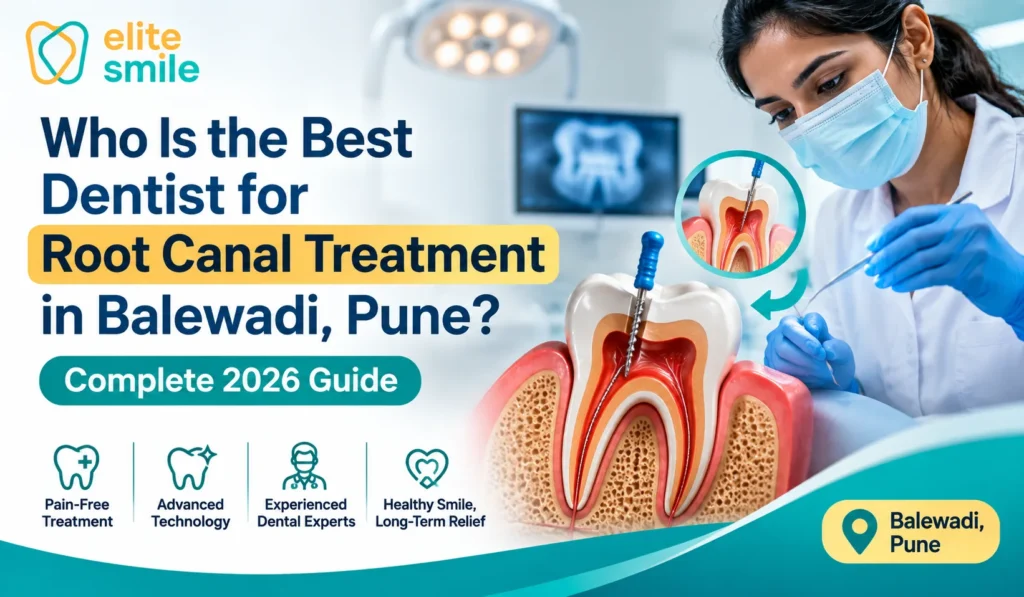
Tooth pain rarely waits for a convenient time. One minute you’re going about your day; the next, chewing hurts, sleep becomes difficult, and you’re searching “best dentist for root canal in Balewadi” at 11 PM, looking for a trusted answer.
The good news? Root canal treatment (RCT) is designed to treat infection or damage inside a tooth while helping preserve your natural tooth. But choosing the right dentist matters just as much as understanding the procedure.
This 2026 guide is built around the questions patients actually ask in a dental clinic — how to identify a dentist with relevant RCT experience, what happens during treatment, whether it hurts, what affects the cost, and when saving a tooth may be preferable to extraction. The information is presented from a patient-first perspective, with clinical guidance and local context for Balewadi, Pune, so you can compare your options and make a more informed decision.
What Is Root Canal Treatment and When Do You Need It?
Root canal treatment is a dental procedure that removes infected or inflamed tissue (the “pulp”) from inside a tooth, cleans out the canal, and seals it to stop the infection from spreading. The goal is simple: save your natural tooth instead of pulling it out.
Signs You Might Need a Root Canal
Your tooth usually gives you warning signs before things get serious. Watch out for:
- Severe or persistent tooth pain, especially when biting or chewing
- Lingering sensitivity to hot or cold that doesn’t go away quickly
- Swelling or tenderness in the gums near a specific tooth
- Deep decay or a large, old filling that’s breaking down
- A cracked, chipped, or otherwise damaged tooth
- Darkening or discoloration of a single tooth
- A recurring pimple-like bump on the gums (a sign of infection)
If any of this sounds familiar, it’s worth getting it checked rather than waiting it out. Infections inside a tooth don’t heal on their own — they only get more painful and more expensive to treat.
Who Is the Best Dentist for Root Canal Treatment in Balewadi?
When you’re searching for the best dentist for root canal treatment in Balewadi, the answer isn’t necessarily the dentist with the highest rating or the most advertisements. The right choice depends on your specific dental condition, the dentist’s experience, the quality of diagnosis, treatment approach, technology, hygiene standards, and the level of care provided before and after RCT.
A dentist you can consider for root canal treatment should ideally have:
- Relevant dental qualifications and hands-on RCT experience
- The ability to manage routine cases and identify when endodontic expertise may be appropriate
- A thorough clinical examination supported by suitable dental imaging
- Modern dental equipment and techniques appropriate to the patient’s condition
- Strong infection-control and sterilization practices
- Recent, genuine patient feedback that provides more context than a star rating alone
- Clear communication about the diagnosis, treatment options, expected visits, and cost factors
- Appropriate follow-up and aftercare guidance
Meet Dr. Krunali Talekar — Dentist in Balewadi
For patients exploring dental care in Balewadi, Dr. Krunali Talekar (BDS) at Elite Smile Dental Clinic is one local dental professional you can consider when evaluating your options. Her approach focuses on personalized dental care, patient communication, comfort, hygiene, and the use of modern dental techniques and technology.
For someone who feels anxious about root canal treatment, the experience matters beyond the procedure itself. Being able to discuss your symptoms, understand the diagnosis, ask questions about available treatment options, and know what to expect during and after RCT can make the decision much easier.
Why E-E-A-T matters when choosing a dentist
Dental treatment is a healthcare decision, so online information should help patients evaluate providers rather than simply tell them who is “the best.” Look for identifiable qualifications, relevant clinical experience, a verifiable clinic presence, transparent communication, appropriate diagnostic methods, and authentic patient experiences.
For root canal treatment in Balewadi, Pune, these factors provide a more meaningful basis for choosing a dentist than rankings, advertisements, or star ratings alone. A good dental consultation should ultimately determine whether RCT is appropriate for your tooth and explain the available alternatives based on your individual condition.
Absolutely. I’d make each point ~50 words, with a patient-first hook, practical advice, and natural Balewadi/Pune SEO relevance rather than forcing keywords into every paragraph.
7 Things to Check Before Choosing a Root Canal Dentist in Balewadi
Choosing a dentist for root canal treatment is about more than finding the closest clinic or highest Google rating. A few simple checks can help you understand whether the dentist is the right fit for your tooth, your comfort, and your treatment needs.
1. Experience With Root Canal Procedures
Wondering whether experience really matters? Ask how frequently the dentist performs root canal procedures and whether they handle different types of teeth. Front teeth and molars can present different challenges. For patients looking for a root canal dentist in Balewadi Pune, relevant hands-on experience is an important factor to discuss during consultation.
2. Endodontic Expertise
What if your case is more complicated than a routine RCT? An endodontist has specialized training in treating problems involving the dental pulp and root canals. Complex anatomy, retreatment, or persistent infection may require specialist assessment. Ask your dentist whether your case can be managed in-house or needs an endodontic referral.
3. Diagnosis Before Treatment
Still unsure which tooth is actually causing the pain? A proper diagnosis should come before treatment. Your dentist may examine the tooth, assess your symptoms, and use appropriate dental imaging when necessary. This helps identify the source of the problem and determine whether root canal treatment is actually the right option.
4. Modern RCT Technology
Can technology make your root canal experience better? Depending on the case, tools such as digital X-rays, rotary instruments, and apex locators can support accurate treatment planning and canal preparation. Technology alone doesn’t guarantee better care, but appropriate equipment combined with clinical expertise can contribute to efficient and controlled RCT treatment in Balewadi.
5. Hygiene and Sterilization
One question you should never feel awkward asking: “How do you maintain sterilization?” Root canal treatment involves working within the tooth, making infection control an essential part of dental care. Look for a clinic that follows appropriate sterilization, disinfection, and hygiene procedures. Your comfort matters, but your safety comes first.
6. Patient Reviews and Experience
Don’t judge a dentist by stars alone. Read recent patient reviews and look for specific experiences involving communication, treatment explanations, comfort, waiting time, and follow-up. A detailed review can provide more useful context than a rating by itself. When comparing dentists in Balewadi, Pune, consider patterns across multiple reviews.
7. Transparent Pricing and Aftercare
Before starting treatment, ask one simple question: “What will I need after the RCT?” A trustworthy dental consultation should explain the treatment plan, expected visits, relevant cost factors, and restoration requirements. Depending on the tooth and remaining structure, a crown or other restoration may be recommended after root canal treatment.
How Is Root Canal Treatment Performed?
If you’re considering a root canal, knowing what happens at each stage can make the process feel much less uncertain.
1. Dental Examination
The dentist examines your tooth, gums, symptoms, and bite to understand the problem. This initial assessment helps determine whether root canal treatment is appropriate.
2. X-Ray or Dental Imaging
Dental X-rays or other appropriate imaging help the dentist assess the tooth’s roots, canal structure, surrounding bone, and possible infection before treatment begins.
3. Local Anesthesia
Local anesthesia numbs the affected area before treatment. This helps minimize discomfort while the dentist works on the tooth and prepares it for root canal therapy.
4. Accessing the Infected Area
The dentist creates a small opening through the tooth to reach the infected or inflamed pulp inside, while preserving as much healthy tooth structure as possible.
5. Cleaning and Shaping the Canals
The infected or inflamed pulp is removed, and the root canals are carefully cleaned and shaped to prepare them for thorough filling and sealing.
6. Filling and Sealing
After cleaning, the canals are filled with a suitable biocompatible material and sealed. This helps prevent bacteria from entering the treated root canal system.
7. Restoration or Dental Crown
After RCT, the tooth may need a filling, crown, or other restoration depending on its location, remaining structure, and risk of fracture during normal use.
8. Follow-Up and Aftercare
Your dentist may recommend a follow-up appointment to assess the treated tooth and discuss restoration, healing, oral hygiene, and any symptoms that need attention.
How Many Visits Does Root Canal Treatment Take?
Some root canal cases can be completed in one appointment, while others require multiple visits. The number depends on the tooth, infection, anatomy, and treatment complexity.
I’d refine this section slightly because some of these are treatment approaches or procedures rather than strictly “types” of root canal treatment. That distinction improves clinical accuracy and E-E-A-T. Here is a more patient-friendly version:
Types and Approaches to Root Canal Treatment
Not every root canal case is managed in exactly the same way. The treatment approach can depend on the tooth involved, the condition of the pulp, the extent of infection, the canal anatomy, and whether the tooth has been treated previously.
1. Single-Sitting Root Canal Treatment
In suitable cases, cleaning, shaping, and filling the root canals can be completed during one appointment. Whether this approach is appropriate depends on the tooth’s condition, infection status, canal anatomy, and the dentist’s clinical assessment.
2. Multi-Sitting Root Canal Treatment
Some cases require more than one appointment. This may be considered when there is significant infection, complex canal anatomy, or other clinical factors requiring additional treatment before the canals can be permanently filled and sealed.
3. Rotary Endodontic Treatment
Rotary endodontics uses motor-driven instruments to help clean and shape the root canals. These instruments can support efficient and controlled canal preparation. The dentist decides which instruments and techniques are appropriate based on the individual tooth.
4. Root Canal Retreatment
A previously treated tooth may sometimes develop persistent symptoms or infection and require retreatment. The dentist may remove the existing filling material, reassess and clean the canals, and reseal them. Complex retreatment cases may require assessment by an endodontist.
5. Pulpotomy and Pulpectomy
Pulpotomy and pulpectomy are pulp-treatment procedures used particularly in children’s dentistry, although their use depends on the tooth and clinical situation. A pulpotomy removes affected pulp from the crown, while a pulpectomy involves removing pulp tissue from the canals.
6. Surgical Endodontics (Apicoectomy)
An apicoectomy is a surgical endodontic procedure that may be considered when infection or inflammation persists around the root tip after conventional root canal treatment or when nonsurgical retreatment is not suitable. The procedure involves accessing the root tip surgically and removing the affected tissue.
Which Root Canal Approach Is Right for You?
There is no single treatment approach that works for every patient. After examining the tooth and reviewing appropriate imaging, your dentist can explain whether you need a single-visit treatment, multiple appointments, retreatment, or another endodontic procedure.
Understanding the recommended approach can also help you ask practical questions about treatment time, number of visits, expected costs, restoration requirements, and aftercare before starting treatment.
Is Root Canal Treatment Painful?
Worried about pain during a root canal? Here’s what you should know:
- 🦷 During the procedure: Local anesthesia is normally used, so you should not feel sharp pain while the dentist treats the tooth.
- 💉 What you may feel: Pressure, vibration, or movement can sometimes be noticeable even when the area is numb.
- 😬 After treatment: Mild tenderness or sensitivity, especially while biting, can occur for a few days.
- ⏳ Recovery: Discomfort generally improves as the treated tooth settles and heals.
- 💊 Pain relief: Your dentist can recommend appropriate pain-management and aftercare based on your individual condition.
- ⚠️ Don’t rely on “100% painless” promises: Pain and recovery can vary depending on the tooth, infection, and individual sensitivity.
- 👨⚕️ Ask questions: A trustworthy dentist should explain the procedure, expected sensations, treatment options, and aftercare before starting.
- 🚨 When to contact your dentist: Seek professional advice if pain becomes severe, swelling develops or increases, or symptoms don’t improve as expected.
Modern root canal treatment is generally performed with local anesthesia and is intended to relieve the pain caused by an infected or inflamed tooth while preserving the natural tooth when possible.
How Many Sittings Does Root Canal Treatment Take?
Wondering whether your root canal will be completed in one visit or require multiple appointments? There isn’t a fixed number of sittings for every patient. The treatment timeline depends on the condition and complexity of the affected tooth.
- Type of tooth: Front teeth may have simpler canal systems, while molars often have multiple canals and can require more detailed treatment.
- Extent of infection: A significant or persistent infection may require additional visits depending on the dentist’s assessment and treatment plan.
- Canal anatomy: Curved, narrow, or complex canals can make treatment more technically demanding.
- Previous root canal: Retreatment cases may require additional planning and appointments.
- Final restoration: A filling or dental crown may be needed after RCT to restore the tooth’s strength and function.
- Single-sitting RCT: Some suitable cases can be completed in one appointment when the clinical conditions allow.
- Multiple sittings: Other cases may require two or more visits to complete cleaning, treatment, sealing, and restoration appropriately.
The key takeaway: Don’t choose a dentist simply because they promise “single-sitting RCT.” A responsible treatment plan should be based on your tooth’s condition, infection, anatomy, and restoration needs.
Root Canal Treatment Cost in Balewadi, Pune
Wondering how much a root canal will cost? The honest answer is that there isn’t one fixed price for every patient. The final estimate depends on the tooth, its condition, treatment complexity, and the restoration required afterward.
Before choosing a clinic based only on a low quoted price, consider these factors:
- Type of tooth: Front teeth and molars can have different treatment requirements. Molars often have multiple canals and may require more complex treatment.
- Number of canals: The number, shape, and accessibility of the canals can influence the time and complexity involved.
- Infection or inflammation: A more complicated infection may require additional treatment or appointments.
- Diagnosis and imaging: Dental X-rays or other appropriate imaging may be needed to assess the tooth and plan treatment.
- Treatment approach: The techniques and equipment used may vary depending on the dentist, tooth anatomy, and clinical requirements.
- Crown or restoration: After RCT, the tooth may need a filling, crown, or another restoration depending on how much healthy tooth structure remains.
- Professional expertise: Fees can also vary based on the dentist’s qualifications, experience, and whether specialist endodontic care is required.
- Consultation and estimate: Ask for a clear treatment plan and cost estimate before starting, including any expected restoration costs.
How to Get an Accurate RCT Cost
The most reliable way to understand your root canal treatment cost in Balewadi is to have the tooth examined by a qualified dentist. Ask what is included in the estimate, whether additional visits may be required, and whether a crown or other restoration will be recommended.
Remember: The cheapest quoted price isn’t necessarily the best value. Focus on appropriate diagnosis, quality treatment, transparent pricing, and proper follow-up care.
Root Canal Treatment vs. Tooth Extraction
Not sure whether you should save the tooth or have it removed? The right choice depends on the tooth’s condition, restorability, infection, and long-term prognosis. A dentist should assess these factors before recommending either option.
| Factor | Root Canal Treatment | Tooth Extraction |
|---|---|---|
| What it does | Removes infected or inflamed pulp, then cleans and seals the tooth | Removes the affected tooth completely |
| Natural tooth | Preserves the natural tooth when it can be restored | The natural tooth is no longer retained |
| Chewing function | Can maintain normal function after appropriate restoration | May require an implant, bridge, or denture to replace the missing tooth |
| Effect on nearby teeth | Helps maintain the existing tooth arrangement | An unreplaced missing tooth can contribute to movement of nearby teeth over time |
| Restoration | A filling or crown may be recommended depending on the tooth | Replacement may be considered depending on location and individual needs |
| When it may be suitable | When the tooth is sufficiently healthy and restorable after removing the infected pulp | When the tooth cannot be predictably restored or has a poor long-term prognosis |
| Long-term goal | Preserve the natural tooth and restore its function | Remove a tooth that cannot be predictably saved and consider appropriate replacement |
Which Option Is Better?
If a natural tooth can be predictably restored, preserving it with root canal treatment may be an appropriate option. However, RCT isn’t always the right choice.
Extraction may be recommended when the tooth has extensive structural damage, a severe fracture that makes restoration impractical, inadequate remaining tooth structure, or another condition that gives it a poor long-term prognosis.
The decision should be based on a professional examination, appropriate imaging, restorability, and your individual dental circumstances — not simply on cost or a general rule that one treatment is always better.
The goal is not just to remove pain; it’s to choose the treatment that provides the most appropriate long-term outcome for your tooth and overall oral health.
Do You Need a Crown After Root Canal Treatment?
Often, yes — but not always. A tooth that’s had root canal treatment can become more brittle over time since it no longer has a live blood supply. A crown adds strength and protects the tooth from cracking, especially for molars that handle heavy chewing pressure.
Whether you need one depends on:
- How much natural tooth structure remains
- Which tooth was treated (molars need crowns more often than front teeth)
- The size of the access opening made during treatment
Your dentist should walk you through this decision as part of your treatment plan — not as an unexpected add-on cost afterward.
Best Areas to Find a Root Canal Dentist Near Balewadi
If you’re searching from anywhere in West Pune, root canal specialists serving Balewadi typically also cover these nearby areas:
- Balewadi & Balewadi High Street
- Baner
- Wakad
- Mahalunge
- Aundh
- Pashan
- Hinjewadi
- Pimple Saudagar
- Sangvi
- sus road
- pashan
- bavdhan
If a clinic is a short drive from any of these localities, it’s worth including in your shortlist — proximity matters when you need a follow-up visit or a same-day emergency appointment.
What Makes a Root Canal Dentist Different From a General Dentist?
All endodontists are dentists, but not all dentists are endodontists.
- A general dentist handles routine care — cleanings, fillings, and many standard RCT cases.
- An endodontist has additional specialized training focused entirely on the tooth’s pulp and root canal system, and typically handles more complex or repeat cases, retreatments, and unusual canal anatomy.
For a straightforward infection, a good general dentist is often perfectly capable. For complicated, recurring, or previously failed root canal cases, ask specifically about referral to an endodontist.
How to Compare Root Canal Dentists in Balewadi
Use this as a practical checklist during your research or first consultation:
| Factor | What to Check |
|---|---|
| Experience | Relevant RCT experience with your specific tooth type |
| Qualification | BDS/MDS or specialized endodontic training |
| Diagnosis | Clinical examination plus appropriate imaging |
| Technology | Modern equipment where clinically appropriate |
| Reviews | Recent, detailed patient experiences |
| Hygiene | Clear sterilization and infection-control practices |
| Cost | Transparent, written treatment estimate |
| Restoration | Clear plan for crown or restoration if needed |
| Follow-up | Defined post-treatment guidance |
| Location | Easy accessibility from Balewadi, Baner, or Wakad |
Going through this list with two or three clinics before deciding will tell you far more than any single Google review ever could.
How to Choose the Right Root Canal Dentist in Balewadi
Tooth pain can make you want an immediate solution, but choosing the right dentist is worth a little extra time. Before booking your root canal, check the dentist’s qualifications and relevant experience, ask how the tooth will be diagnosed, understand your treatment options, and request a clear estimate of the expected costs.
If you’re comparing dental clinics in Balewadi, consider factors such as clinical experience, diagnostic care, hygiene standards, patient communication, treatment technology, reviews, and follow-up support rather than relying on advertising or star ratings alone.
Dr. Krunali Talekar at Elite Smile Dental Clinic is one local option you can consider as part of your research. Ultimately, the right dentist is the one who carefully evaluates your individual tooth, explains the available options clearly, and recommends treatment based on your clinical needs.
If you’re experiencing persistent tooth pain, swelling, sensitivity, or discomfort while chewing, don’t ignore it. A timely dental evaluation can help you understand what’s causing the problem and what treatment options are appropriate for you.
Frequently Asked Questions
Who is the best dentist for root canal treatment in Balewadi?
There isn’t one dentist who is the best for every patient. Look for relevant RCT experience, proper diagnosis, appropriate technology, good hygiene practices, transparent treatment planning, and recent patient feedback. Dr. Krunali Talekar at Elite Smile Dental Clinic in Balewadi is one local option patients can consider when comparing dental care providers.
Where can I get root canal treatment in Balewadi, Pune?
Root canal treatment is available at dental clinics throughout Balewadi and nearby areas such as Baner, Wakad, Aundh, and Mahalunge. When choosing a clinic, consider the dentist’s RCT experience, diagnostic process, treatment facilities, reviews, and follow-up care rather than location alone.
How much does root canal treatment cost in Balewadi?
The cost varies depending on the tooth, number and complexity of canals, infection, diagnostic requirements, treatment approach, and whether a crown or other restoration is needed. For an accurate estimate, have the tooth examined and ask for a clear treatment plan before starting.
Is root canal treatment painful?
Root canal treatment is generally performed under local anesthesia, which helps control pain during the procedure. Some patients may experience tenderness or sensitivity afterward, particularly while biting. Your dentist can provide appropriate aftercare and pain-management advice based on your individual condition.
How many sittings are required for RCT?
There is no fixed number of appointments for every case. Some straightforward cases may be completed in one sitting, while complex infections, unusual canal anatomy, or retreatment cases may require additional visits. Your dentist can explain the expected treatment timeline after examination and imaging.
Can root canal treatment be completed in one sitting?
Yes, some suitable cases can be completed in a single appointment. However, single-sitting treatment isn’t appropriate for every tooth. The decision depends on factors such as infection, canal anatomy, tooth condition, and the dentist’s clinical assessment.
What are the signs that I need a root canal?
Possible warning signs include persistent tooth pain, prolonged hot or cold sensitivity, pain while chewing, swelling, deep decay, a cracked or damaged tooth, or discoloration of one tooth. These symptoms can have different causes, so a dental examination is necessary before deciding on RCT.
Should I get a root canal or tooth extraction?
If a tooth can be predictably restored, root canal treatment may allow you to preserve the natural tooth. Extraction may be considered when the tooth is severely damaged, cannot be adequately restored, or has a poor long-term prognosis. Your dentist should assess restorability before recommending either option.
Do I need a crown after root canal treatment?
A crown or another restoration may be recommended depending on the tooth’s location, remaining structure, and risk of fracture. Molars and premolars often require careful consideration for cuspal protection, while the restoration plan for front teeth may differ. Your dentist can recommend the appropriate option.
How do I choose the right root canal dentist?
Look at the dentist’s qualifications, relevant RCT experience, diagnostic approach, treatment technology, sterilization practices, patient reviews, communication, and pricing transparency. A consultation before treatment gives you an opportunity to understand the diagnosis, options, expected visits, costs, and aftercare.
A Note on Accuracy and Trust
This guide is written for general informational purposes to help you make a confident, informed decision — it isn’t a substitute for an in-person dental examination. Every tooth and every infection is different, so treatment timelines, pain levels, and costs mentioned here are general ranges, not guarantees. For an accurate diagnosis and treatment plan specific to your tooth, consult a licensed dentist directly.
About the reviewer: Dr. Krunali Talekar (BDS) practices at Elite Smile Dental Clinic in Balewadi, Pune, with a focus on patient-first, comfortable dental care including root canal treatment. This article reflects clinical best practices commonly followed in modern dental care as of 2026.