Tooth pain has a way of taking over your entire day. If you’re reading this at 11 PM with an ice pack on your cheek, here’s the short answer first:
The best root canal dentist in Baner is not simply the one with the highest rating or the lowest price. It’s a dentist who diagnoses the problem accurately, explains your treatment options clearly, uses appropriate modern technology, and focuses on saving your natural tooth whenever possible.
And while single-sitting root canal treatment can be suitable for some patients, it isn’t the right approach for every tooth or every infection.
That’s the quick answer. Now let’s look at what actually matters when choosing
root canal treatment in Baner, Pune — from the warning signs that mean you shouldn’t wait, to the treatment process, expected costs, crowns, single-visit RCT, and re-root canal treatment — so you can make an informed decision instead of choosing a dentist based on guesswork alone.
Meet Dr. Krunali Talekar — Dentist in Baner, Pune
For patients exploring dental care options in the area,
Dr. Krunali Talekar (BDS) at
Elite Smile Dental Clinic is one local dental professional worth knowing about. She’s treated
720+ patients, created
81+ smiles, and brings
5+ years of experience to every appointment, backed by a
5-star Google rating for care and commitment.
Her approach at this dental clinic in Baner, Pune is built around a few simple ideas:
- Personalized treatment — customized care plans designed around your specific needs, smile goals, and comfort
- Advanced dental technology — for more accurate diagnosis and precise, predictable results
- Family-friendly care — gentle treatment for children, teens, adults, and seniors alike
- Honest communication — clear guidance on diagnosis, options, and costs before any treatment begins
The clinic offers a full range of services beyond root canal treatment, including dental implants, braces, aligners, teeth whitening, tooth extraction, dentures, pediatric dentistry, and smile designing — so whatever brought you here, it’s a reasonable place to get evaluated.
Why Might You Need Root Canal Treatment?
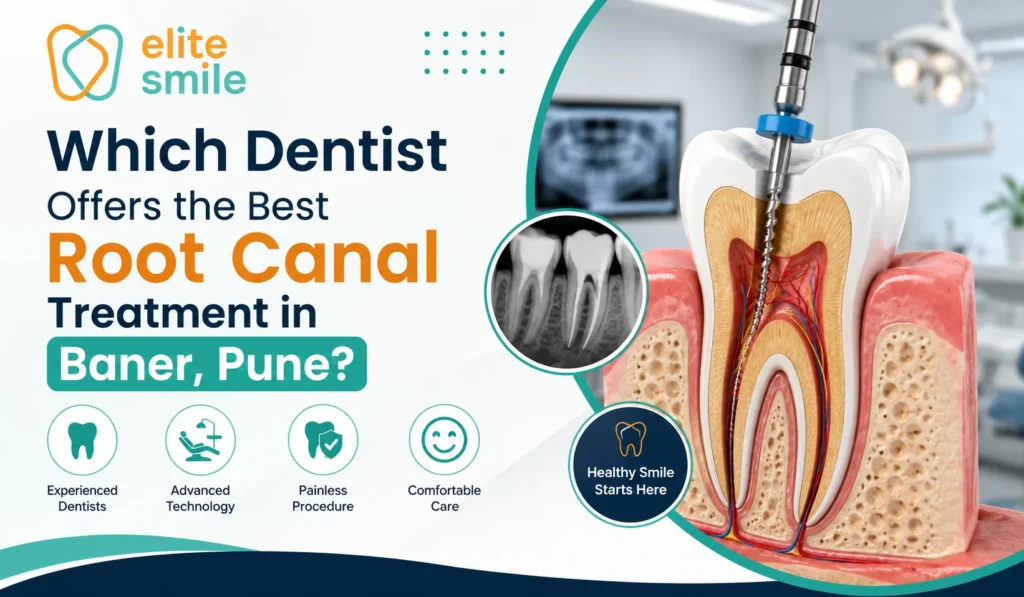
Not every toothache means you need a root canal. But certain symptoms can indicate that the pulp — the soft tissue containing nerves and blood vessels inside your tooth — may be inflamed or infected. Recognising these warning signs early can help you get the right treatment before the problem becomes more complicated.
What Are the Signs You May Need a Root Canal?
Common warning signs include:
- Sharp, throbbing, or persistent tooth pain, particularly with hot or cold foods and drinks
- Tooth pain that becomes worse at night or disturbs your sleep
- Swelling around the affected tooth or a small pimple-like bump on the gum
- A tooth that has become noticeably darker or grey
- Pain or tenderness when biting, chewing, or touching the tooth
- Persistent sensitivity that continues after the hot or cold trigger is removed
Having one or more of these symptoms doesn’t automatically mean you need an RCT. A dentist needs to examine the tooth and, when appropriate, take an X-ray to determine the cause.
Does Severe Tooth Pain Always Mean You Need an RCT?
No. Severe tooth pain can have several causes, including deep decay, gum problems, a cracked tooth, a damaged filling, or an irritated dental nerve.
That’s why a proper dental examination is important. Your dentist may use clinical tests and dental X-rays to determine whether the pulp is inflamed or infected and whether root canal treatment in Baner, Pune is appropriate.
Treating the actual cause — not simply treating the pain — is what matters.
Can a Tooth Infection Be Treated Without Root Canal Treatment?
It depends on how advanced the problem is.
If decay or damage has not reached the tooth’s pulp, a dentist may be able to treat the tooth with a filling or another restorative procedure. However, when the pulp becomes irreversibly inflamed or infected, root canal treatment may be needed to remove the damaged tissue and preserve the natural tooth.
Antibiotics are not a substitute for root canal treatment when the infected pulp is the source of the problem. They may sometimes be prescribed when there are signs of spreading infection or systemic involvement, but the underlying dental problem still needs appropriate treatment.
Can a Cracked or Injured Tooth Require RCT?
Yes, sometimes. A crack, sports injury, accident, fall, or repeated trauma can damage the pulp inside a tooth. In some cases, symptoms may appear immediately; in others, pulp damage can develop gradually.
Whether an injured tooth needs RCT depends on the location and severity of the crack or injury, the condition of the pulp, and whether the tooth can be restored.
What Happens If an Infected Tooth Is Left Untreated?
A dental infection generally won’t resolve simply because the pain temporarily improves. As the infection progresses, it can cause swelling, an abscess, bone damage around the tooth, and potentially tooth loss.
⚠️ If you have facial swelling, fever, difficulty swallowing or breathing, or rapidly worsening pain, seek urgent dental or medical care rather than waiting for a routine appointment.
The key takeaway: Tooth pain is a symptom, not a diagnosis. If you’re experiencing persistent pain, sensitivity, swelling, or tenderness, getting the tooth evaluated early can help determine whether you need root canal treatment, another dental procedure, or no RCT at all.
How Do You Choose the Best Root Canal Dentist in Baner?
Choosing a dentist for a root canal isn’t just about finding the clinic closest to you or picking the first result on Google. The dentist’s qualifications, experience, diagnostic approach, technology, hygiene standards, communication, and aftercare can all influence your overall treatment experience.
What Qualifications Should a Root Canal Dentist Have?
Start by checking whether the dentist is BDS or MDS qualified and has relevant experience performing root canal procedures. Dentists with additional training in endodontics (root canal treatment) may be particularly useful for complex cases.
A general dentist can perform many routine root canals, while complicated anatomy, retreatment, calcified canals, or difficult cases may require referral to or treatment by an endodontic specialist.
Does Experience Matter When Choosing an RCT Dentist?
Yes, experience can matter — especially when a tooth has complicated root anatomy.
Root canals can vary considerably between patients. Some teeth may have narrow, curved, calcified, or difficult-to-locate canals. An experienced dentist is better equipped to assess these challenges and determine the most appropriate treatment approach.
However, experience alone shouldn’t be your only deciding factor. Look at it alongside diagnosis, treatment planning, technology, communication, and patient care.
What Technology Does a Modern Dental Clinic Use?
Technology can help a dentist diagnose and treat root canal problems more precisely. Depending on the case, ask whether the clinic uses:
- Digital X-rays or RVG for detailed dental imaging
- Rotary or reciprocating endodontic instruments for cleaning and shaping canals
- Electronic apex locators to help determine working length
- Dental magnification or microscopes for difficult RCT and retreatment cases
- Digital imaging and documentation to support treatment planning
Not every patient needs every technology. The important question is whether the dentist uses the appropriate tools for your specific tooth and treatment needs.
Should You Check Patient Reviews Before Choosing a Dentist?
Yes, but don’t rely on the star rating alone.
Read several recent reviews and look for consistent comments about:
- Pain management
- Communication
- Appointment experience
- Treatment explanations
- Clinic hygiene
- Follow-up care
- Overall patient experience
A pattern across multiple genuine reviews can tell you considerably more than a single five-star rating.
Is the Dentist Transparent About Treatment Options and Costs?
A good dentist should explain what is wrong with your tooth, why RCT may be recommended, what alternatives may exist, how many visits might be required, and what additional restoration may be needed.
Ask for an estimated treatment cost before starting. Remember that the final cost can vary depending on the tooth, complexity of the infection, number of visits, whether retreatment is required, and whether a crown or other restoration is needed.
If you’re comparing the cost of root canal treatment in Baner, make sure you’re comparing the same treatment components rather than choosing purely on the lowest quoted price.
Does the Clinic Follow Proper Sterilisation Protocols?
Yes — hygiene and infection-control practices should be a basic part of dental care.
A dental clinic should follow appropriate sterilisation and infection-control procedures, including proper processing of reusable instruments, appropriate use of disposable items, and maintaining a clean clinical environment.
Don’t hesitate to ask the clinic how instruments are sterilised if you’re unsure.
Who Is a Good Example of a Root Canal Dentist in Baner?
If you’re researching dentists in Baner,
Dr. Krunali Talekar (BDS) at
Elite Smile Dental Clinic can be one local option to consider.
Her patient-care approach focuses on personalised treatment, clear communication, hygiene, and modern dental care.
Rather than choosing a dentist solely because a page calls them the “best,” compare practical factors such as qualifications, relevant experience, treatment technology, patient reviews, hygiene practices, transparency, and follow-up support.
For patients who feel anxious about root canal treatment, being able to openly discuss symptoms, understand the diagnosis, ask questions, and know what to expect can make the treatment experience considerably more comfortable.
Quick tip: The “best” root canal dentist isn’t necessarily the one with the biggest marketing claim. It’s the dentist who can accurately diagnose your problem and recommend the right treatment for your particular tooth.
What Makes Root Canal Treatment Different at a Modern Dental Clinic?
Root canal treatment has changed significantly with advances in dental techniques and technology. But modern treatment isn’t simply about having more equipment. The real benefit comes from using the right technology and technique for the individual tooth, along with accurate diagnosis and careful treatment planning.
What Is Painless Root Canal Treatment?
The phrase “painless root canal treatment” generally refers to a procedure performed with effective local anaesthesia and appropriate pain-management techniques.
During a properly anaesthetised RCT, most patients should feel little or no sharp pain, although they may experience pressure or vibration. Some tenderness or mild discomfort can occur after treatment and usually settles as the tooth and surrounding tissues recover.
So, rather than promising that RCT will be completely sensation-free, a better question to ask is:
How does the dentist manage pain and anxiety before, during, and after treatment?
What Technology Can Improve RCT Accuracy?
Modern endodontic technology can help dentists diagnose, clean, shape, and fill root canals more effectively. Depending on the case, this may include:
- Rotary or reciprocating instruments to clean and shape canals efficiently
- Electronic apex locators to help determine the working length of the canal
- Digital X-rays/RVG for detailed dental imaging
- Magnification or dental microscopes for complex canals and retreatment
- Advanced irrigation techniques to help clean areas instruments cannot directly reach
Technology doesn’t guarantee treatment success on its own. Accurate diagnosis, treatment planning, clinical skill, and proper sealing of the tooth are equally important.
Is Single-Sitting Root Canal Treatment Possible?
Yes, in selected cases.
A single-visit or single-sitting RCT may be appropriate when the dentist can adequately clean, shape, disinfect, and seal the canals during one appointment.
However, it isn’t suitable for every patient. The decision can depend on factors such as the tooth involved, canal anatomy, infection, presence of an abscess, and the dentist’s clinical assessment.
Therefore, “single sitting” shouldn’t automatically be considered better than multiple visits. The priority should be thorough and appropriate treatment.
Does Every Patient Need the Same Type of RCT?
No. Root canal treatment is highly individualised.
Your treatment plan may depend on:
- Which tooth is affected
- The number and shape of its root canals
- The severity of pulp inflammation or infection
- Whether an abscess is present
- Previous dental treatment
- Whether the tooth has already undergone RCT
- The condition of the remaining tooth structure
A straightforward front-tooth RCT can be very different from treating a molar with multiple curved canals or performing a re-root canal treatment on a previously treated tooth.
What Role Does Digital Imaging Play in Root Canal Treatment?
Digital imaging can give the dentist valuable information about the tooth and surrounding structures before and during treatment.
RVG/digital X-rays can help assess the depth of decay, root structure, existing restorations, and changes around the root. In selected complex cases, 3D imaging such as CBCT may provide additional information that conventional two-dimensional X-rays cannot show.
The goal isn’t simply to use more scans. It’s to use the appropriate imaging when it can improve diagnosis or treatment planning while avoiding unnecessary radiation exposure.
The Bottom Line
When comparing root canal treatment in Baner, Pune, don’t focus only on whether a clinic advertises “painless RCT,” “laser RCT,” or “single-sitting RCT.” Ask why that particular approach is appropriate for your tooth.
A modern root canal treatment combines accurate diagnosis, appropriate technology, sound clinical technique, effective pain management, proper infection control, and a restoration that protects the treated tooth afterward.
Is Root Canal Treatment Painful?
This is probably the question on your mind right now, so let’s address it directly.
Does RCT Hurt During the Procedure?
With proper anaesthesia, you shouldn’t feel pain during the actual treatment — most people describe it as similar to getting a filling done.
What Type of Anaesthesia Is Used?
Local anaesthesia is used to numb the tooth and surrounding area completely before any drilling or cleaning begins.
Is There Pain After Root Canal Treatment?
Mild soreness or sensitivity for a day or two is common and normal, especially while chewing. This usually settles with basic pain relief as advised by your dentist.
How Can Discomfort After RCT Be Managed?
- Take medication exactly as prescribed
- Avoid chewing on the treated side until it’s restored
- Stick to soft foods for the first day
- Use a cold compress if there’s mild swelling
When Should You Contact Your Dentist After Treatment? If pain increases instead of easing, if swelling appears, or if you notice an unusual taste or discharge, contact your dentist promptly rather than waiting it out.
How Long Does Root Canal Treatment Take?
Can a Root Canal Be Completed in One Visit?
Often, yes — particularly for teeth with a straightforward infection and clear canal anatomy.
How Many Appointments Might RCT Require?
More complex cases, especially molars with multiple curved canals or an existing infection, may need two or more visits for the best outcome.
What Factors Determine the Treatment Time?
- Which tooth is involved (front teeth vs molars)
- Severity and spread of infection
- Canal shape and any calcification
- Whether it’s a first RCT or a retreatment
Does a Complicated Infection Require Additional Visits?
Yes. If there’s significant infection, the dentist may place medication inside the tooth first and complete the treatment in a follow-up visit once the infection settles.
How Much Does Root Canal Treatment Cost in Baner, Pune?
What Affects the Cost of RCT in Baner?
- The tooth involved (molars typically cost more than front teeth due to more canals)
- Number of sittings required
- Technology used (rotary vs manual instrumentation)
- Whether a crown is needed afterward
Does the Type of Tooth Affect the Price?
Yes. Molars have more canals and are more time-intensive to treat than incisors or canines, which usually reflects in the cost.
Does Single-Sitting RCT Cost More?
Not always — but it may involve advanced instrumentation, which can factor into the overall price.
Is a Dental Crown Included in the Treatment Cost?
Usually not. A crown is typically quoted and billed separately from the root canal procedure itself.
Why Can Root Canal Prices Vary Between Clinics?
Because of differences in technology, dentist experience, materials used, and the clinic’s location. It’s best to get a personalized quote after an in-clinic consultation and X-ray, rather than relying on a generic number online.
Note: We haven’t listed a fixed price here because RCT cost genuinely depends on your specific tooth and condition — an honest dentist will only quote after examining you.
Do You Need a Crown After Root Canal Treatment?
Why Is a Crown Sometimes Recommended After RCT?
A root-canal-treated tooth loses some structural strength and can become brittle over time. A crown protects it from cracking under everyday biting force.
Does Every Root Canal-Treated Tooth Need a Crown?
Not always. Front teeth with minimal structure loss might only need a filling, while molars — which bear more chewing pressure — usually benefit from a crown.
How Does a Crown Protect a Treated Tooth?
It covers and seals the tooth completely, distributing biting force evenly and preventing fractures.
When Should a Crown Be Placed After RCT?
Typically within a few weeks of completing the root canal, once the tooth has settled and any temporary filling is ready to be replaced with a permanent restoration.
What Happens If You Don’t Restore a Weakened Tooth?
It’s at a much higher risk of cracking or breaking, which could mean losing the tooth entirely — undoing the whole purpose of the root canal.
What Is Single-Sitting Root Canal Treatment?
Single-sitting RCT means completing the main root canal procedure in one appointment, when clinically appropriate.
Can RCT Really Be Completed in One Visit?
Yes. Some straightforward cases can be cleaned, shaped, disinfected, and filled in a single visit.
Who Is Suitable for Single-Visit RCT?
Patients with manageable canal anatomy and no complications may be suitable. Your dentist will decide after examination and imaging.
Is Single-Sitting RCT Better Than Multiple-Visit Treatment?
Not always. The best approach depends on the tooth, infection, canal complexity, and overall clinical condition.
Does Every Infected Tooth Qualify for Single-Sitting RCT?
No. Complex canals, significant infection, or an abscess may require multiple visits for appropriate treatment.
What Is Re-Root Canal Treatment and When Is It Needed?
Re-root canal treatment (re-RCT) is a second attempt to treat a tooth after a previous root canal hasn’t healed properly or becomes infected again.
Can a Root Canal Fail? Yes. Although RCT can have a high success rate, failure can occur due to missed canals, persistent infection, new decay, leakage around a restoration, or a cracked tooth.
What Are the Signs of a Failed RCT?
- Pain or discomfort returning
- Swelling or a recurring gum bump
- Tenderness when biting
- Persistent infection around the root
Why Might a Tooth Need Re-Root Canal Treatment?
Re-RCT aims to remove persistent or newly introduced infection, clean the canal system again, and seal the tooth properly.
Is Re-RCT Better Than Tooth Extraction?
When the tooth can be predictably restored, saving the natural tooth may be a preferred option. Your dentist should assess the tooth before recommending retreatment or extraction.
When Is Retreatment Not Possible?
Re-RCT may not be suitable when there is a vertical root fracture, severe structural damage, or insufficient healthy tooth structure to restore the tooth. In such cases, extraction may need to be considered.
Root Canal vs Tooth Extraction: Which Is Better?
When a tooth is badly infected or damaged, the choice often comes down to saving the natural tooth with root canal treatment or removing it through extraction. The right option depends on the tooth’s condition and whether it can be predictably restored.
Can a Natural Tooth Always Be Saved With RCT?
No. Some teeth cannot be successfully restored with root canal treatment. However, when a tooth has enough healthy structure and can be treated predictably, preserving the natural tooth is often considered.
When Might Extraction Be Recommended?
Extraction may be considered when there is:
- A severe or untreatable crack
- A vertical root fracture
- Extensive loss of supporting bone
- Insufficient tooth structure for restoration
- A tooth that cannot be predictably treated or restored
Your dentist may recommend an examination and imaging before making this decision.
Is Saving Your Natural Tooth Better Than Extraction?
When feasible, keeping your natural tooth can have important advantages. A natural tooth helps maintain chewing function and avoids immediately replacing it with an implant, bridge, or denture.
However, saving a tooth isn’t always the best option if its long-term prognosis is poor.
What Happens After Tooth Extraction?
After extraction, your dentist may discuss replacement options such as a dental implant, bridge, or partial denture, depending on your oral health and individual needs.
Replacing a missing tooth can help restore function and may help prevent unwanted movement of neighbouring teeth.
Can a Root Canal Help Avoid Tooth Replacement?
Yes. The main goal of root canal treatment is to remove infected or damaged pulp while preserving the natural tooth whenever possible.
If the tooth can be successfully treated and restored, RCT may allow you to keep your natural tooth instead of moving directly to extraction and tooth replacement.
What Should You Expect During Root Canal Treatment?
Knowing what happens during root canal treatment in Baner, Pune can make the procedure feel much less intimidating. While the exact process varies by tooth and case, RCT generally follows these steps:
Consultation → Diagnosis → Anaesthesia → Cleaning → Shaping → Filling → Restoration → Follow-up
What Happens During the First Appointment?
Your dentist examines the tooth, reviews your symptoms, and may take an X-ray or other appropriate imaging. This helps determine whether the pulp is damaged or infected and whether RCT is the right treatment.
How Is the Infected Pulp Removed?
After local anaesthesia, the dentist creates a small opening in the tooth and removes the inflamed or infected pulp from the root canals. The canals are then carefully cleaned and shaped.
How Is the Tooth Sealed?
After cleaning and disinfecting the canals, they are filled with a biocompatible material and sealed to help prevent bacteria from entering again.
When Is the Final Restoration Placed?
The tooth is restored with a filling, crown, or other suitable restoration, depending on how much tooth structure remains and which tooth was treated. A crown may be recommended for teeth that need additional protection.
What Happens After RCT?
Some tenderness can occur for a few days. Follow your dentist’s instructions, avoid putting excessive pressure on the treated tooth until it’s properly restored, and attend any recommended follow-up appointments.
What Questions Should You Ask a Root Canal Dentist Before Treatment?
Walk in prepared with these:
- Do I definitely need a root canal?
- Can my tooth be saved?
- How many visits will I need?
- What type of RCT is suitable for me?
- Will I need a crown afterward?
- What will the estimated treatment cost be?
- What should I expect after treatment?
Asking these upfront shows a good dentist you’re an informed patient — and gives you clarity before committing to treatment.
How Can You Find a Trusted Root Canal Dentist Near Baner?
Finding the right root canal dentist in Baner, Pune isn’t only about proximity. Look at the dentist’s qualifications, relevant experience, diagnostic approach, patient feedback, hygiene standards, technology, treatment options, and follow-up support before making your decision.
Which Areas Near Baner Have Dental Clinics?
Baner has convenient access to dental clinics for patients from nearby areas such as Balewadi, Pashan, Aundh, and Sus. If you’re searching for RCT, consider clinics based on treatment quality and accessibility rather than distance alone.
Is There a Root Canal Dentist Near Balewadi?
Yes. Patients in Balewadi and Baner can find dental clinics offering root canal treatment nearby. When comparing options, check the dentist’s qualifications, reviews, treatment approach, and whether the clinic handles both routine RCT and more complex cases.
Can Patients Find RCT Dentists Near Pashan?
Yes. Pashan residents can access several dental clinics around the Baner-Pashan area. Before booking, check whether the dentist provides the specific treatment you need and whether follow-up appointments are convenient for you.
What Should Patients Check in Google Reviews?
Don’t look at the star rating alone. Read recent reviews and look for consistent feedback about:
- Pain management
- Dentist communication
- Treatment explanations
- Clinic cleanliness
- Appointment experience
- Follow-up and aftercare
How Can You Verify a Dentist’s Qualifications?
Check the dentist’s BDS/MDS qualification, professional registration, relevant clinical experience, and any additional endodontic training. Reliable information may be available through the clinic’s official website or professional registration records.
Is There a Trusted Dental Clinic in Baner You Can Visit?
If you’re comparing options,
Elite Smile Dental Clinic, led by
Dr. Krunali Talekar (BDS), is one local clinic you can research for dental care in Baner. The clinic provides services including root canal treatment, dental implants, braces, aligners, teeth whitening, tooth extraction, dentures, pediatric dentistry, and smile designing.
If you’re considering a first-time RCT, re-root canal, or simply want a second opinion, compare the clinic’s diagnostic approach, treatment plan, expected costs, technology, and aftercare before making your decision.
What Most Root Canal Blogs in Baner Don’t Tell You
Many root canal articles explain the procedure but don’t answer the practical questions patients have when choosing a dentist. Here are some factors worth considering before you book an appointment.
Does Diagnosis Matter More Than the Procedure Itself?
Accurate diagnosis comes before treatment. Tooth pain can have several causes, and RCT isn’t appropriate for every type of toothache.
A dentist may use your symptoms, clinical tests, dental X-rays, and other appropriate diagnostic methods to determine whether the pulp is inflamed or infected. A careful diagnosis helps avoid unnecessary treatment and identifies cases that may require a different approach.
Why Do Two Clinics Quote Different Prices for the Same Root Canal?
There isn’t always a single price for RCT because treatment complexity varies. The final cost can depend on:
- Type of tooth and number of canals
- Complexity of the canal anatomy
- Whether it is a first-time RCT or retreatment
- Imaging and diagnostic requirements
- Number of appointments
- Materials and techniques used
- Whether a crown or another restoration is required
So when comparing root canal treatment cost in Baner, ask what is included in the quoted price rather than comparing one headline number with another.
What Happens If You Delay Root Canal Treatment?
If your dentist has diagnosed an infected or irreversibly damaged pulp, delaying recommended treatment can allow the problem to progress. Infection may spread beyond the tooth and can eventually result in an abscess or damage to surrounding bone.
If pain suddenly disappears, that doesn’t necessarily mean the problem has healed. Don’t use the absence of pain as proof that an infection is gone.
What If My First RCT Didn’t Work?
A previously treated tooth that develops persistent or recurring symptoms may need re-evaluation, rather than automatically undergoing another procedure.
Your dentist may assess the tooth with clinical examination and imaging to identify possible causes such as missed canals, persistent infection, leakage, new decay, or a fracture.
Depending on the findings, options may include re-root canal treatment, surgical endodontic treatment, restoration, or extraction.
What Should Good Aftercare Support Look Like?
Ask the clinic what happens after your RCT, not just during it.
Good aftercare should include clear instructions about eating, pain management, restoration, warning signs, and when to return for follow-up. You should also know whom to contact if symptoms don’t improve or become worse.
Ultimately, choosing a root canal dentist in Baner is about more than finding a clinic that promises “painless RCT.” Look for accurate diagnosis, appropriate treatment planning, good communication, proper infection control, suitable technology, transparent costs, and reliable follow-up care.
Important Things to Know Before and After Your Root Canal
Knowing what to expect before and after root canal treatment in Baner, Pune can make the experience easier and help protect your treated tooth.
What Are Common Root Canal Myths You Shouldn’t Believe?
| Myth |
Reality |
| “Root canals are extremely painful.” |
With effective local anaesthesia, most patients should not experience significant pain during treatment. |
| “Extraction is always better.” |
If a tooth can be predictably saved, preserving the natural tooth may avoid the need for replacement. |
| “A root canal-treated tooth won’t last.” |
With proper restoration and good oral care, a treated tooth can remain functional for many years. |
| “If the pain stops, I don’t need RCT.” |
Pain disappearing doesn’t necessarily mean the infection has resolved. The tooth may still require treatment. |
What Should You Do Before Your Root Canal Appointment?
- Eat normally unless your dentist gives you different instructions
- Tell your dentist about medications, allergies, and relevant health information
- Follow any specific pre-treatment instructions provided by the clinic
- Write down your symptoms and questions beforehand
- Tell your dentist if you’re anxious about dental treatment
What Should You Avoid Immediately After Root Canal Treatment?
- Avoid chewing hard foods on the treated tooth until it has been properly restored
- Choose softer foods if the area feels tender
- Follow your dentist’s medication and aftercare instructions
- Don’t repeatedly bite on or test the treated tooth
- Contact your dentist if pain or swelling becomes worse rather than improving
How Should You Take Care of a Root Canal-Treated Tooth Long-Term?
- Complete the recommended permanent filling or crown on time
- Brush twice daily and floss regularly
- Attend routine dental examinations
- Avoid chewing ice, pens, or other very hard objects
- Seek dental advice if the tooth develops new pain, swelling, or sensitivity
What If You’re Nervous or Anxious About the Procedure?
Dental anxiety is common. Tell your dentist before treatment begins. A good dentist can explain the procedure, discuss pain-control options, answer your questions, and give you breaks when needed.
The goal isn’t just to complete the RCT — it’s to make sure you understand what’s happening and feel comfortable throughout the process.
Frequently Asked Questions About Root Canal Treatment
These FAQs are designed to answer the questions patients commonly ask before choosing root canal treatment in Baner, Pune, while also covering cost, pain, treatment time, technology, single-sitting RCT, re-RCT, crowns, and choosing a dentist.
1. Which dentist offers the best root canal treatment in Baner, Pune?
There isn’t one objectively “best” dentist for every patient. The right dentist is one who accurately diagnoses the tooth, explains the treatment options, has relevant RCT experience, uses appropriate diagnostic and treatment technology, follows good infection-control practices, and provides clear aftercare.
For straightforward cases, a general dentist with strong RCT experience may be suitable. More complicated cases — such as difficult canal anatomy or retreatment — may benefit from an endodontist, a dentist with additional specialised training in saving teeth.
When comparing dentists in Baner, look beyond a “5-star” claim and consider qualifications, clinical experience, patient feedback, treatment approach, transparency, and convenience for follow-up visits.
2. What is the cost of root canal treatment in Baner, Pune?
There is no single price that applies to every root canal treatment. The final cost can vary depending on:
- Which tooth requires treatment
- Number and complexity of the canals
- Severity of infection
- Whether it is a first-time RCT or re-RCT
- Number of appointments required
- Diagnostic imaging
- Materials and techniques used
- Whether a filling, crown, or other restoration is required
The most reliable way to get an accurate estimate is to have the tooth examined first. When comparing root canal treatment cost in Baner, ask exactly what the quoted price includes rather than choosing purely on the lowest number.
3. Is root canal treatment painful?
Modern root canal treatment is generally performed under local anaesthesia, so most patients should be comfortable during the procedure. You may still feel pressure or vibration, but sharp pain should be addressed by your dentist.
Some tenderness or mild discomfort can occur for a few days afterward, particularly if the tooth was already infected. Modern anaesthesia and techniques generally make RCT comfortable for most patients.
If you’re anxious about dental treatment, tell your dentist before the procedure so appropriate pain and anxiety-management measures can be discussed.
4. How long does a root canal take?
Treatment time varies according to the tooth and complexity of the case.
A straightforward root canal may sometimes be completed in one appointment, while other teeth may require more than one visit. Molars, complicated canal anatomy, significant infection, or retreatment can require additional treatment time. Root canals can commonly be completed in one or two appointments depending on the tooth and individual circumstances.
5. Can RCT be completed in one sitting?
Yes, selected cases can be completed in a single sitting. The dentist needs to determine whether the canals can be adequately cleaned, disinfected, shaped, and sealed during the appointment. The decision may depend on:
- Canal anatomy
- Tooth type
- Level of infection
- Presence of an abscess
- Whether this is initial treatment or retreatment
- The patient’s individual clinical condition
Single-sitting RCT isn’t automatically better than multiple-visit treatment. The priority should be complete and appropriate treatment rather than simply finishing as quickly as possible.
6. Do I need a crown after root canal treatment?
You may, depending on the tooth and how much healthy structure remains.
Back teeth such as molars often experience substantial chewing forces and may require additional protection after RCT. Your dentist will assess the remaining tooth structure and recommend a suitable restoration.
A permanent restoration is important because the tooth needs to be properly sealed and protected after endodontic treatment. Delayed or inadequate restoration can also contribute to problems with a previously treated tooth.
7. How do I know if I need a root canal?
Possible warning signs include:
- Persistent or severe tooth pain
- Pain when biting or chewing
- Lingering sensitivity to hot or cold
- Swelling around the tooth or gum
- A recurring gum pimple
- A cracked or damaged tooth
- Darkening of the tooth
However, symptoms alone cannot confirm that you need RCT. Tooth pain can have several causes, so a dentist may need to perform clinical tests and take appropriate dental imaging before recommending treatment.
8. What is the difference between RCT and re-RCT?
RCT is the initial root canal treatment, while re-RCT is retreatment of a tooth that has already undergone root canal treatment.
A previously treated tooth may need re-RCT if it doesn’t heal properly or develops a new infection. Possible reasons include untreated or missed canals, complicated anatomy, leakage around a restoration, new decay, or a fracture.
A dentist or endodontist should evaluate the tooth before deciding whether retreatment is appropriate.
9. Is root canal treatment better than tooth extraction?
If the tooth can be predictably treated and restored, preserving the natural tooth is often preferred.
Root canal treatment is designed to remove infected or inflamed pulp while allowing the natural tooth to remain in place and function.
However, RCT cannot save every tooth. Severe structural damage, certain fractures, or a tooth that cannot be adequately restored may make extraction the more appropriate option.
If extraction is recommended, ask about replacement options such as an implant, bridge, or denture.
10. How do I choose the best root canal dentist in Baner?
Use a practical checklist rather than relying on one marketing claim:
- Check qualifications and relevant RCT experience
- Look for accurate diagnosis and treatment planning
- Ask what technology is appropriate for your case
- Read recent patient reviews carefully
- Ask about the expected number of visits
- Request a clear explanation of treatment costs
- Find out whether a crown or other restoration will be needed
- Check the clinic’s hygiene and infection-control practices
- Ask about follow-up and aftercare
- Choose a dentist who answers your questions clearly
For complex root canal cases or retreatment, you can also ask whether an endodontic specialist should be involved. Endodontists receive additional specialised training focused on diagnosing and treating problems involving the dental pulp and saving natural teeth.
11. Can antibiotics cure a tooth that needs a root canal?
Antibiotics alone usually don’t remove the underlying source of an infected tooth. When dental treatment is indicated, appropriate dental treatment such as root canal treatment or drainage should generally be prioritised rather than routinely relying on antibiotics for most pulpal and periapical conditions.
Antibiotics may be appropriate in certain situations, particularly when infection is accompanied by systemic signs such as fever or malaise.
So, don’t self-medicate with leftover antibiotics. Get the tooth properly evaluated.
12. What should I ask a dentist before getting an RCT?
Before starting treatment, consider asking:
- Why do I need a root canal?
- Can this tooth be saved?
- Are there alternatives to RCT?
- How many visits might I need?
- Is single-sitting RCT suitable for my case?
- Will I need a crown afterward?
- What will the estimated total cost be?
- What should I expect after treatment?
- What happens if the tooth doesn’t heal properly?
These questions can help you understand your options instead of making a decision based only on price or the promise of “painless” or “single-sitting” treatment.
13. When should I seek urgent dental care for tooth pain?
Don’t ignore severe or worsening tooth pain, especially when it is accompanied by swelling, fever, or significant tenderness. Dental infections can require prompt evaluation and treatment.
If swelling is spreading toward the face or neck or you’re having difficulty breathing or swallowing, seek urgent medical attention.
Quick Takeaway
If you’re searching for the
best root canal treatment in Baner, Pune, don’t ask only,
“Which dentist is number one?” Ask a more useful question:
“Which dentist can accurately diagnose my tooth, explain my options, provide appropriate RCT using suitable techniques, and support me through restoration and follow-up?”
That shift makes the decision much more meaningful — and gives you a better basis for choosing a dentist than rankings, star ratings, or the lowest quoted price alone.
Ready to Get Out of Tooth Pain?
Tooth pain can be difficult to ignore, but waiting for it to disappear doesn’t necessarily mean the underlying problem has gone away. If you’re experiencing persistent tooth pain, prolonged sensitivity, swelling, pain while biting, or a recurring gum bump, it’s worth getting the tooth examined by a dentist.
A timely dental evaluation can help identify whether you need root canal treatment, another restorative procedure, or a different approach altogether.
If you’re looking for
root canal treatment in Baner, Pune, choose a dentist who provides a clear diagnosis, explains your treatment options, discusses the expected cost, and guides you through aftercare and restoration.
Don’t wait until the pain becomes unbearable. Get your tooth checked and understand your options before the problem becomes more complicated.
Your natural tooth may be worth saving — take the first step with a professional dental evaluation.